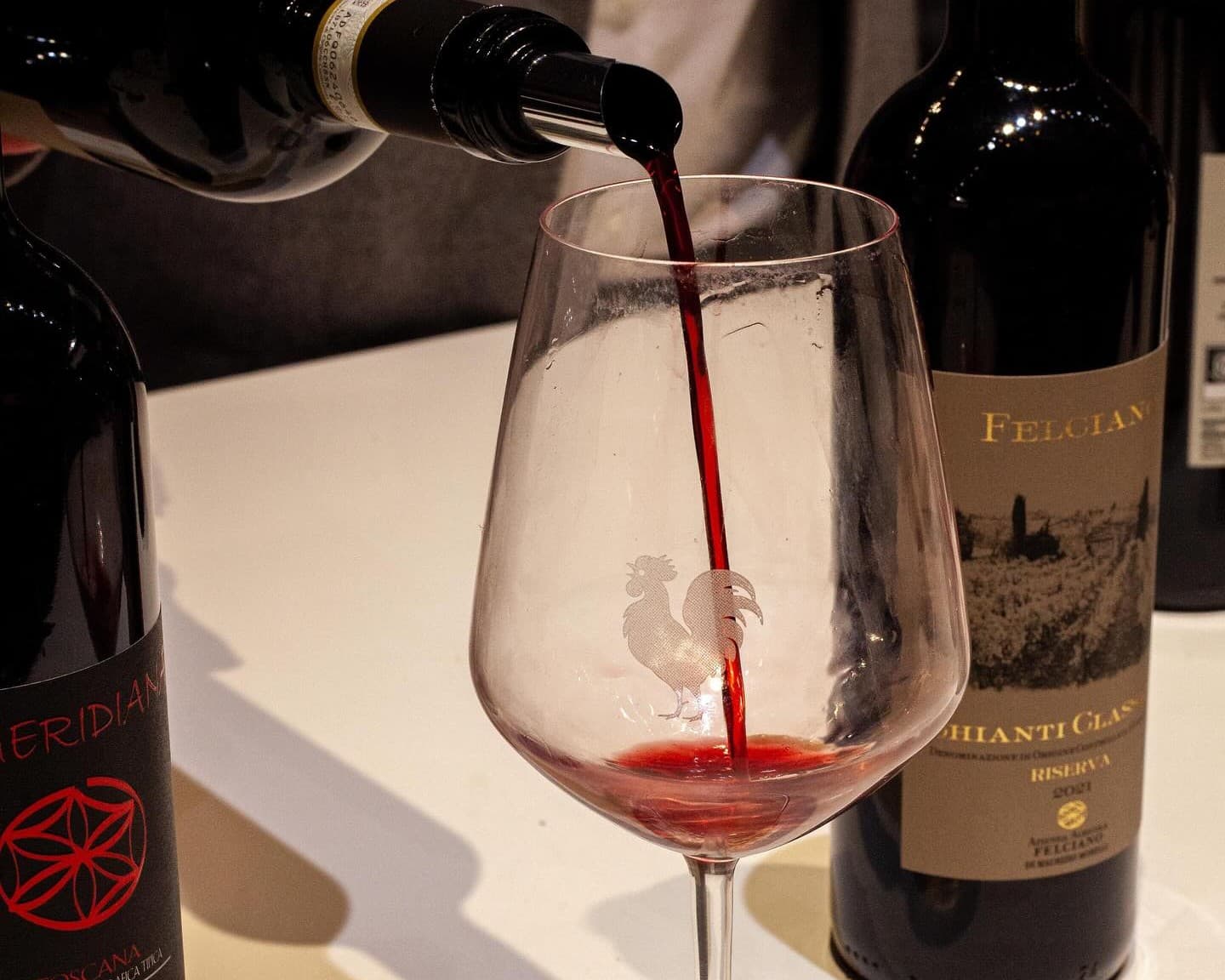

When talking about Chianti, not everyone knows that the famous wine is no longer produced in Chianti itself. Only Chianti Classico originates from the authentic heart of this historic Tuscan region. This distinction, which may seem subtle, is rooted in a narrative rich in history and geography.
Chianti: The Geographical Heart of Tuscany
Chianti is primarily a geographical designation that indicates a specific area of Tuscany, located between Florence and Siena. This picturesque region is characterized by gentle hills and charming villages, boasting a centuries-old winemaking tradition. The municipalities that carry the name Chianti, such as Greve in Chianti, Radda in Chianti, Gaiole in Chianti, and Castellina in Chianti, reflect their deep connection to this historic land. If you ask a Tuscan to show you Chianti on a map, they will undoubtedly point exactly halfway between Florence and Siena.
A Historical Heritage of Winemaking
The wine produced in this area began to gain fame as early as the 1400s. In 1716, a decree known as the "Bando" defined the boundaries within which wine could be labeled as “Chianti.” These boundaries closely align with the area that locals have always considered Chianti. This decree laid the foundation for what we now recognize as a Denomination of Controlled Origin (DOC), a mark of quality and authenticity.
Like other famous wines in the world, Chianti takes its name from the territory of production. However, its story is unique and deserves exploration to understand why it is now primarily produced outside the region itself.
The Evolution of the Name Chianti
In the past, producers located outside the traditional boundaries began labeling their wines as “Chianti” to capitalize on the fame and marketability of the name, which was already well recognized. Some referred to it as “Vino all’uso del Chianti,” meaning wines produced in the same style as Chianti, often using similar grape varieties.
The crucial change occurred in 1931 when the Italian government expanded the designation of Chianti to include a much larger area, extending from Pisa to Arezzo and from the Pistoiese hills to the Val d’Orcia. This decision blurred the lines between the geographical meaning of “Chianti” and the term used for the wine, leading to confusion.
The Search for Distinction
In response to this confusion, producers from the original Chianti region sought to distinguish themselves, giving rise to various sub-zones of Chianti: Chianti Colline Pisane, Chianti Colli Fiorentini, Chianti Colli Senesi, Chianti Montalbano, Chianti Montespertoli, Chianti Colli Aretini, Chianti Rùfina, and, above all, Chianti Classico—the only sub-zone that corresponds to the true Chianti region.
Today, Chianti Classico is a Denomination of Controlled and Guaranteed Origin (DOCG), complete with its own requirements and regulations. In contrast, the broader Chianti encompasses its seven sub-zones, each with different standards and guidelines. This means that within the geographical area of Chianti Classico, no Chianti wines can be produced; only outside of this territory is it possible.
The story of Chianti and Chianti Classico is one of pride, tradition, and the pursuit of authenticity. Although they share a name, their histories, regulations, and geographical roots are distinctly different. Whether you prefer the rich character of Chianti Classico or are curious to explore the broader offerings of Chianti, each bottle tells a unique story of its land So, the next time you uncork a bottle of Chianti, remember: it is more than just a wine it is a reflection of a heritage rich in history and tradition. Explore the flavors of Chianti and discover the true essence of this beloved region!