Artificial intelligence has now entered daily life. We use it to write texts, generate images, translate, search for information, organize work, study, create content, and automate tasks that just a few years ago seemed difficult to delegate to a machine.
But behind every answer generated by a chatbot, behind every image produced in seconds, and behind every new AI model there is not only "software". There is also a very concrete physical infrastructure: data centers, servers, GPUs, networks, electricity, cooling systems, and vast amounts of data.
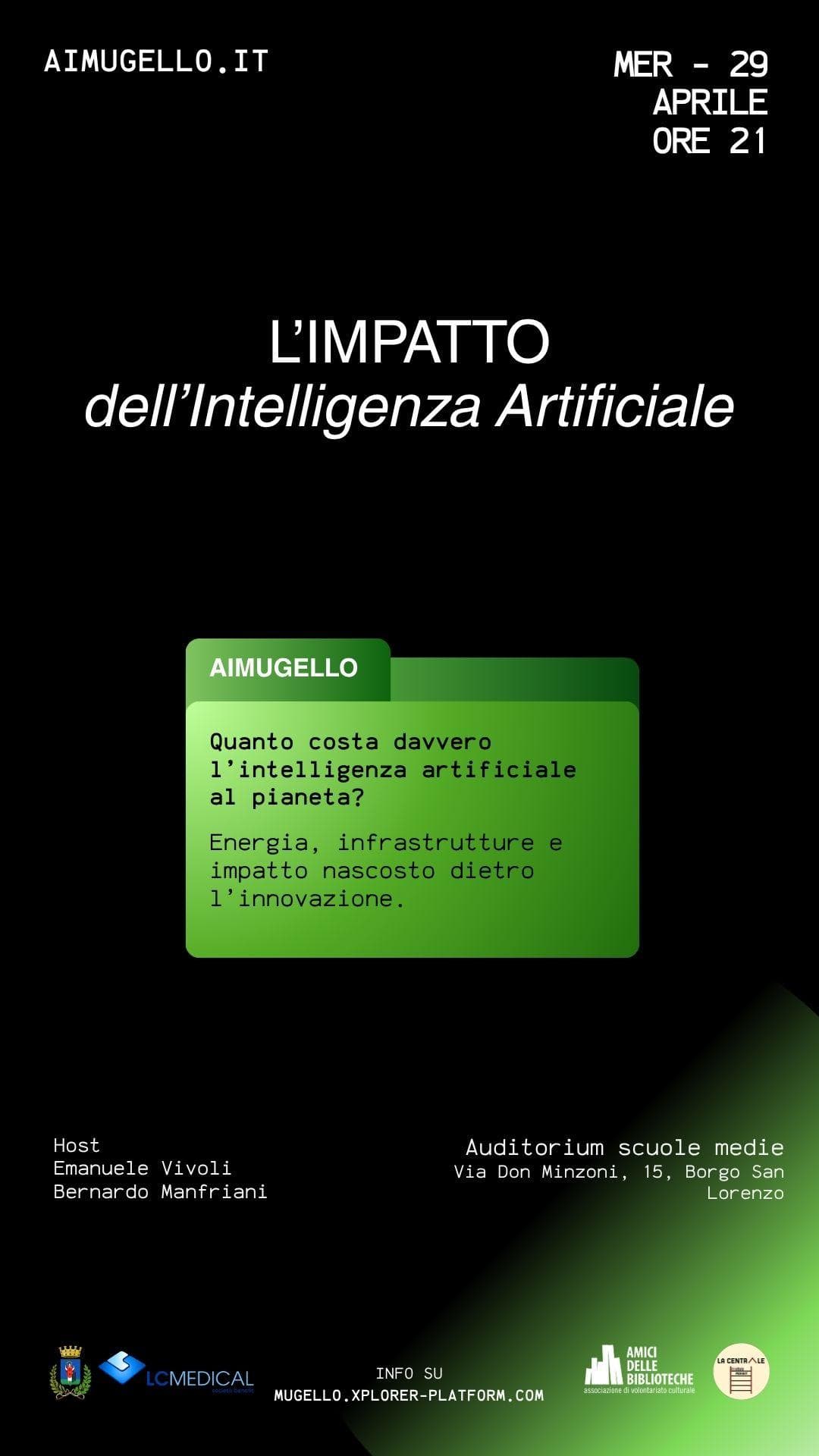
From this very question arises the meeting The Environmental Impact of Artificial Intelligence, organized by AI Mugello, scheduled for Wednesday, April 29, 2026 at 9:00 PM at the Middle School Auditorium, 15 Don Minzoni Street, Borgo San Lorenzo.
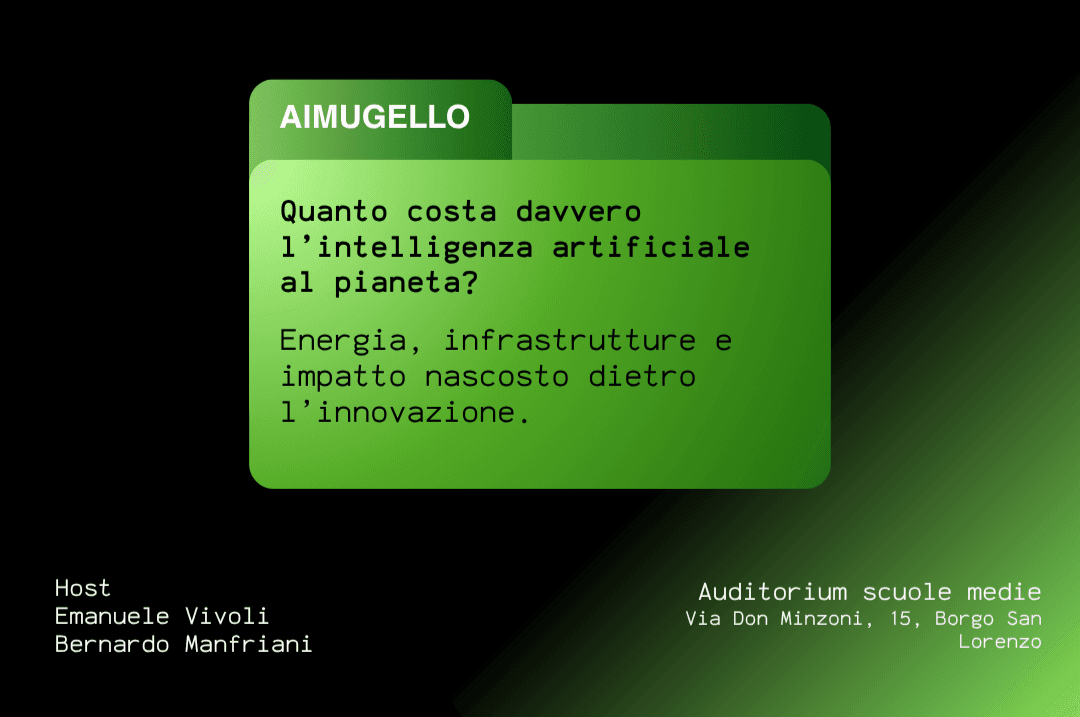
The evening, hosted by Emanuele Vivoli and Bernardo Manfriani, will be an opportunity to talk in simple, concrete terms about what really lies behind artificial intelligence and about how much this technology can affect energy and the environment.
What lies behind an AI response
When we use tools like ChatGPT, digital assistants, or image generators, the experience seems immediate and almost intangible: we type a question, press Enter, and get an answer.
In reality, every interaction activates a complex technological chain. Data travels across the network, reaches computing infrastructures often distributed across large data centers, and is processed by models trained on enormous amounts of information.
During the meeting, this step will be discussed: from the abstract idea of “artificial intelligence” to its material dimension. Because AI does not live in a vacuum: it needs machines, energy, specialized hardware, and ever more powerful infrastructures.
From traditional AI to large generative models
One of the central points of the evening will be understanding how artificial intelligence has changed over time.
Not all AI is equal. There are simpler, specialized algorithms, used for years to classify data, make predictions, or recognize specific patterns. Then there are the more recent models, such as large language models and generative systems, capable of producing texts, images, code, and complex content.
This evolution has brought enormous opportunities, but also new questions: how much computing power is needed to train these models? How significant is everyday, large-scale AI use? What is the difference between training a model and using it? And what does it mean to talk about sustainable AI?
The goal is not to demonize the technology, but to understand it better.
An evening to use AI with greater awareness
The event
The Environmental Impact of Artificial Intelligence
Wednesday, April 29, 2026
9:00 PM
Middle School Auditorium
15 Don Minzoni Street, Borgo San Lorenzo
Hosts of the evening: Emanuele Vivoli and Bernardo Manfriani.
The initiative is promoted by AI Mugello, with the involvement of the entities listed on the poster, and fits into an outreach program dedicated to technology, the region and digital awareness.
An evening to take a step beyond the moment’s enthusiasm and look at artificial intelligence from another perspective: not only what it can do for us, but also what it requires of the planet.