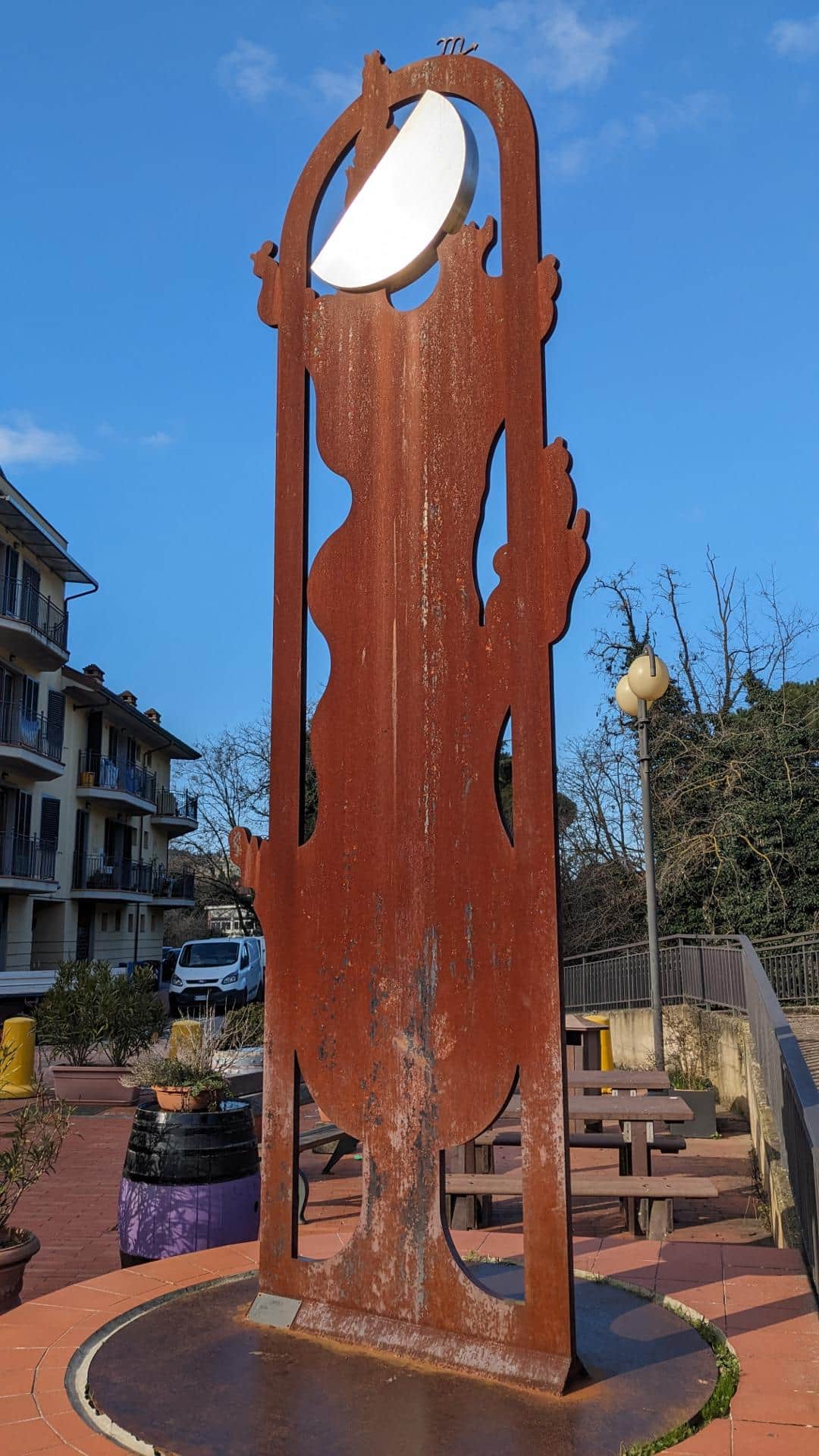
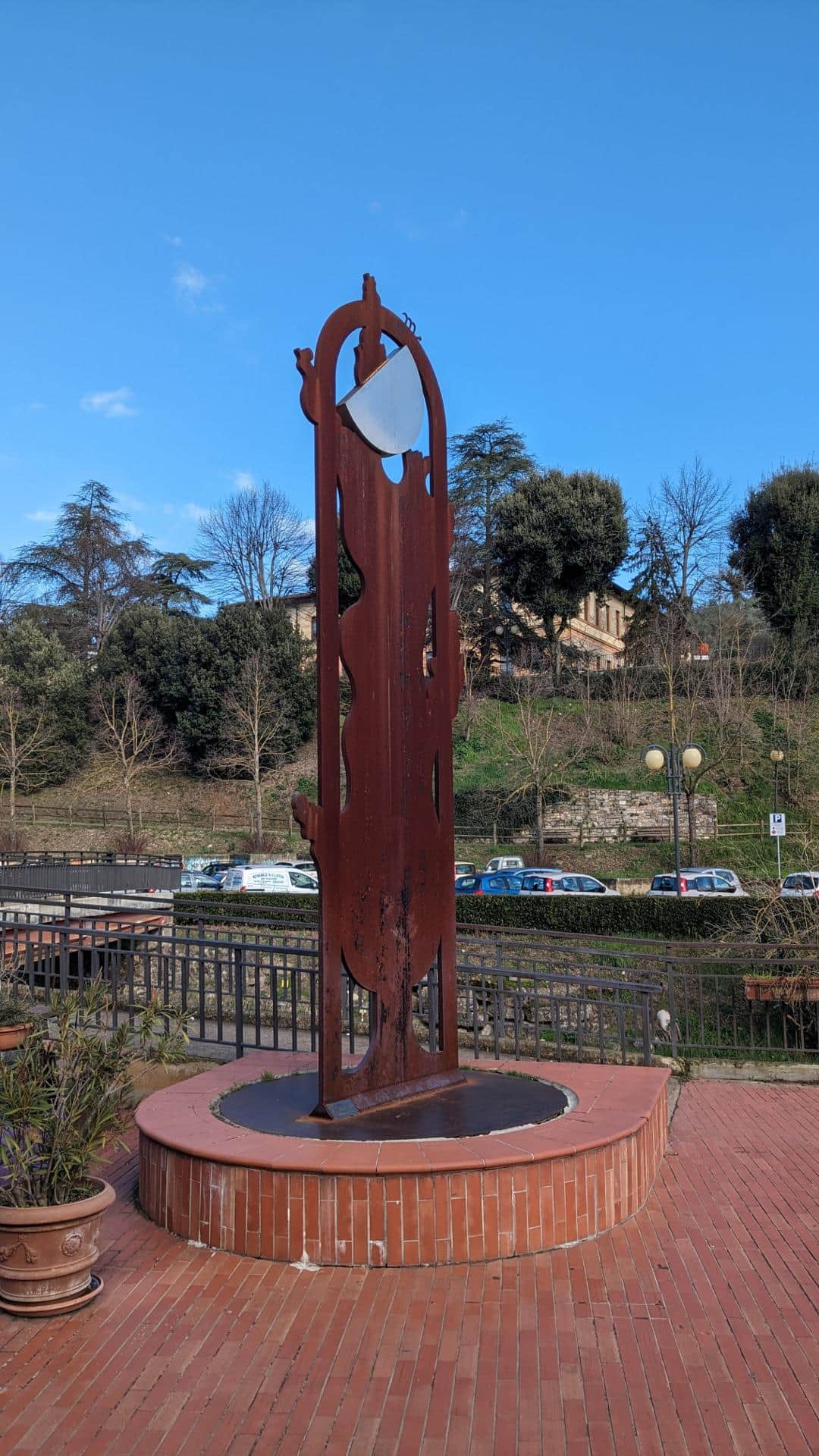
The work entitled 'The Moon and Its Cypress', created by Marcello Guasti for Greve in Chianti, represents a subject that permeates his artistic creativity, manifesting itself in both his drawings and other significant works. Among these, we can mention 'White Cypress and Galaxy' from 2001, 'The Cypress Monument' from 2002, and 'The Dance of the Cypress with the Moon' from 2004. This recurring theme highlights Guasti's deep connection with the cypress and the moon, which become central and inspiring elements of his artistic repertoire.
Through these works, the artist explores and interprets in a unique way the relationship between nature, cosmology, and his personal vision of the world.
The Symbolic Meaning of the Cypress and the Moon
In the 'symbolic' significance of Guasti's sculpture, in addition to his affinity for the often-used curvilinear forms and motifs, the cypress takes on the role of a symbol of the Tuscan land and the souls of warriors killed by the Romans. This symbolism has deep roots in centuries and popular beliefs, which considered the tree as a sacred element for its longevity. The moon, on the other hand, evokes femininity but is also associated with the symbolism of the spiral. In its path from the center upward, the spiral can be considered infinite and, at the same time, cosmic.
The Evolution of Marcello Guasti's Artistic Language
Marcello Guasti, born in Florence in 1924 and residing in Bagno a Ripoli, obtained his diploma from the Magisterium course, Graphics Arts section of the Institute of Art in Florence, under the guidance of Pietro Parigi and Francesco Chiappelli. Initially a painter, he made his debut in sculpture in 1956, creating public works both in Italy and abroad. Over the years, Guasti directed his artistic language towards geometric forms, characterized by interventions on spheres and the use of technological materials such as chrome, stainless steel, and fire paints on metals. During this phase, he created works such as "Concave" and "Signals", recognized by Enrico Crispolti in 1979 for their formal and structural rigor.
Guasti actively participated in numerous solo and group exhibitions worldwide, contributing to the contemporary artistic panorama with his research and innovation in sculptural language.