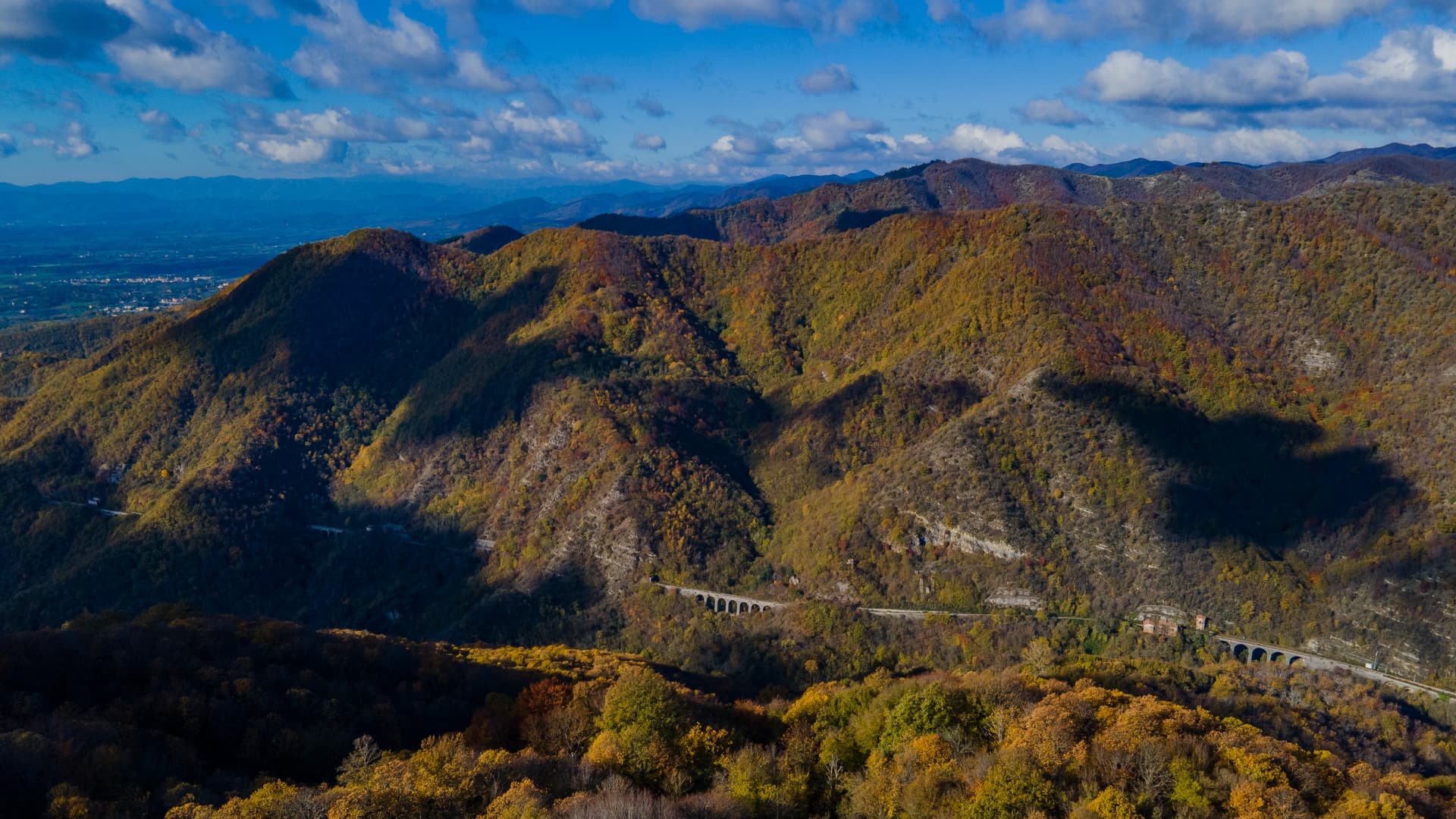
Imagine finding yourself on the tracks, inside a train that crosses woods and valleys, the sound of the rails marking time like in a dream. You enter a tunnel that cuts through the heart of the Apennines, and upon exiting, you find yourself in another world, with snow covering the slopes. This is the Faentina Railway, the historic line that connects Florence to Faenza, a grand undertaking inaugurated in 1893 after years of intense labor, built to make crossing the Apennines possible. Once vital, today it evokes images of another era, with slow trains and landscapes that seem suspended in time.
The Construction:
The construction of the Faentina was a unique engineering challenge for its time. Work began in 1880 and lasted more than ten years, involving the laying of over 100 kilometers of track, twenty-four tunnels, and a complex system of bridges and viaducts. This line represented an important communication route for the Mugello community, fueling the local economy by allowing the transport of materials and people between the small towns of the Apennines and the cities of Florence and Faenza. In Marradi, for instance, a silk mill and a hydroelectric mill were built, powered by the area's natural resources and connected to the rest of the country thanks to the railway.
The Bombings:
During World War II, however, the Faentina faced its most difficult period. Starting in 1944, the line became a target of Allied bombings aimed at cutting off strategic communication routes used by retreating German troops. The railway’s location along one of the crucial connecting axes across the Apennines made it a priority target. Air raids and subsequent sabotage by German troops devastated much of the line, rendering it unusable for over a decade. It wasn't until 1957 that reconstruction efforts began, though the full service between Florence and Faenza remained partially interrupted until 1999, when it was finally reopened, giving the local community back a link to Florence that had been lost for over forty years.
The Fornello Station:
An emblematic place of the Faentina is the Fornello station, now abandoned but full of stories and memories. Situated in a remote area of the Mugello, the station was a microcosm where only a few families tied to railway work lived. During the war, this isolated outpost witnessed the hardships and changes that marked the entire territory. Paolo Casadio's novel The Child from the Train, inspired by life at Fornello, sensitively recounts the simple but intense lives that intertwined in that isolated place, painting a vivid portrait of an era of great transformation. The Fornello station is accessible on foot via a trekking path that starts from Gattaia, a hamlet of Vicchio. The trail also leads to the abandoned mine, but it is important to pay close attention to the still active railway tracks during the hike.
Today:
Today the Faentina has become a symbol of cultural and historical rediscovery, thanks to the tourist project "Dante's Train," which offers a unique travel experience through Tuscany and Romagna. "Dante's Train" travels along the historic route connecting Florence to Ravenna, following in the footsteps of the great poet. For those who undertake this journey, every curve, every tunnel, and every small station is a dive into Italian history, between tales of resilience, war, and reconstruction, in a land that continues to enchant with its beauty and authenticity. The stops along the route provide an opportunity to discover charming towns and villages, making this journey not just a means of travel but also one of discovery and contemplation.
Pics by Davide Fatetti