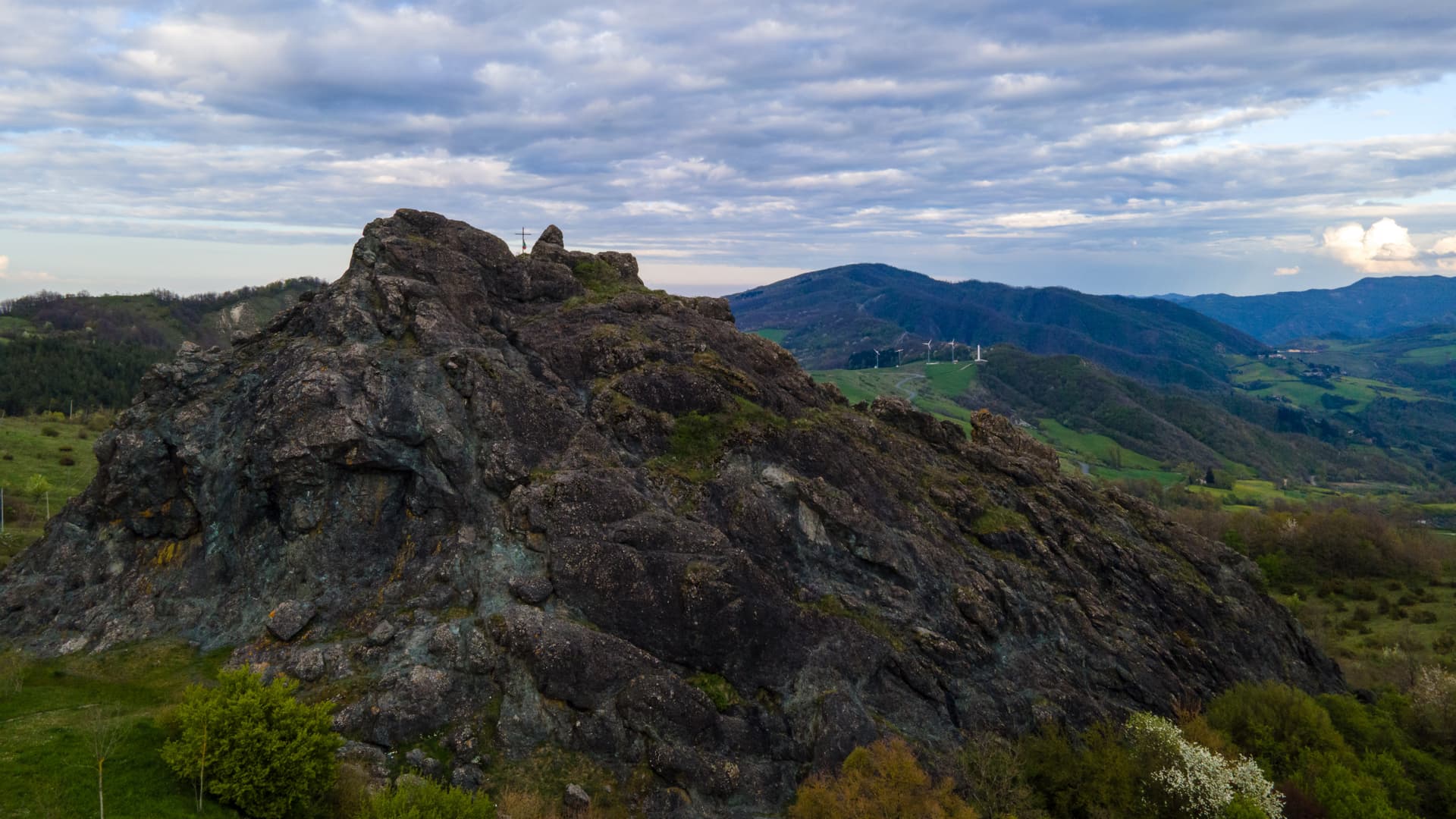
Just a few kilometers from the Raticosa Pass, along the ridge of the Tuscan-Emilian Apennines, stands one of the most fascinating and lesser-known places in the Mugello area: the Rock of San Zanobi. A striking black, triangular-shaped boulder that rises from the plateau and catches the eye with its distinct color and shape a natural spectacle filled with mystery and sacredness.
Nature that resists even the harshest summer
Despite the intense heat and drought of summer, the landscape here remains vibrant. The countless shades of green that cover these ancient mountains offer peace and wonder to travelers heading toward Piancaldoli, a small hamlet in the municipality of Firenzuola. Along this road, suddenly, the famous Rock appears in the distance, standing tall against the bright blue sky.
A story of war and a lost chapel
The Rock of San Zanobi is also tied to a more recent page of history. During World War II, part of the rock was used by Allied forces to repair the provincial road to Piancaldoli. In doing so, they demolished a chapel dedicated to Saint Zanobi that once stood nearby a small sanctuary visible in old photographs, now lost to time.
Who was Saint Zanobi?
Though historical sources are limited, we know that San Zanobi served as Bishop of Florence between the 4th and 5th centuries and is revered as a saint by the Catholic Church. He is credited with numerous miracles, including the famous “miracle of the flowering elm”. According to legend, during the transfer of his remains, an elm tree miraculously bloomed in the dead of winter in Florence’s Piazza San Giovanni. A granite column still stands there today, marking the site of the miracle.
The legend of the Rock
Like every place wrapped in legend, the story of the Rock is no exception. It is said that during his evangelizing mission, San Zanobi was confronted by the Devil on the ridge near Ospedaletto. The Evil One sought to stop him from converting the local people and challenged him to a contest of strength: each would carry a large boulder, and whoever reached the furthest point would win the souls of the land.
San Zanobi carried his rock farther than the Devil, who, exhausted, dropped his own and shattered it. This is how the Rock of the Mantesca (also known as the Devil’s Rock), with its white and blue hues, came to rest in the nearby Sillaro Valley not far from San Zanobi’s dark stone.
Pietramora: a rock older than the mountain
For a long time, locals believed the Rock was a meteorite, due to its black coloring that sharply contrasts with the surrounding clay soil. However, it was later classified as a magmatic seabed rock, formed 150 million years ago a full 60 million years older than the surrounding formations. A true geological relic, a silent witness to an ancient, submerged world.
A place of peace
The air here is light, a fresh breeze whispers across the mountaintops. Silence reigns, and everything seems to radiate calm and serenity. Is it the magic of the landscape? Or just another miracle of San Zanobi?
If you’re searching for a hidden gem in the Mugello where history, myth, and nature come together in perfect harmony, the Rock of San Zanobi is the perfect place for a walk, a moment of reflection, or to simply be amazed.
How to Get There
The Rock is located along the road from the Raticosa Pass to Piancaldoli, in the municipality of Firenzuola (Florence). It can be easily spotted and reached from the nearby parking area, where a breathtaking view of the Apennines unfolds.